|
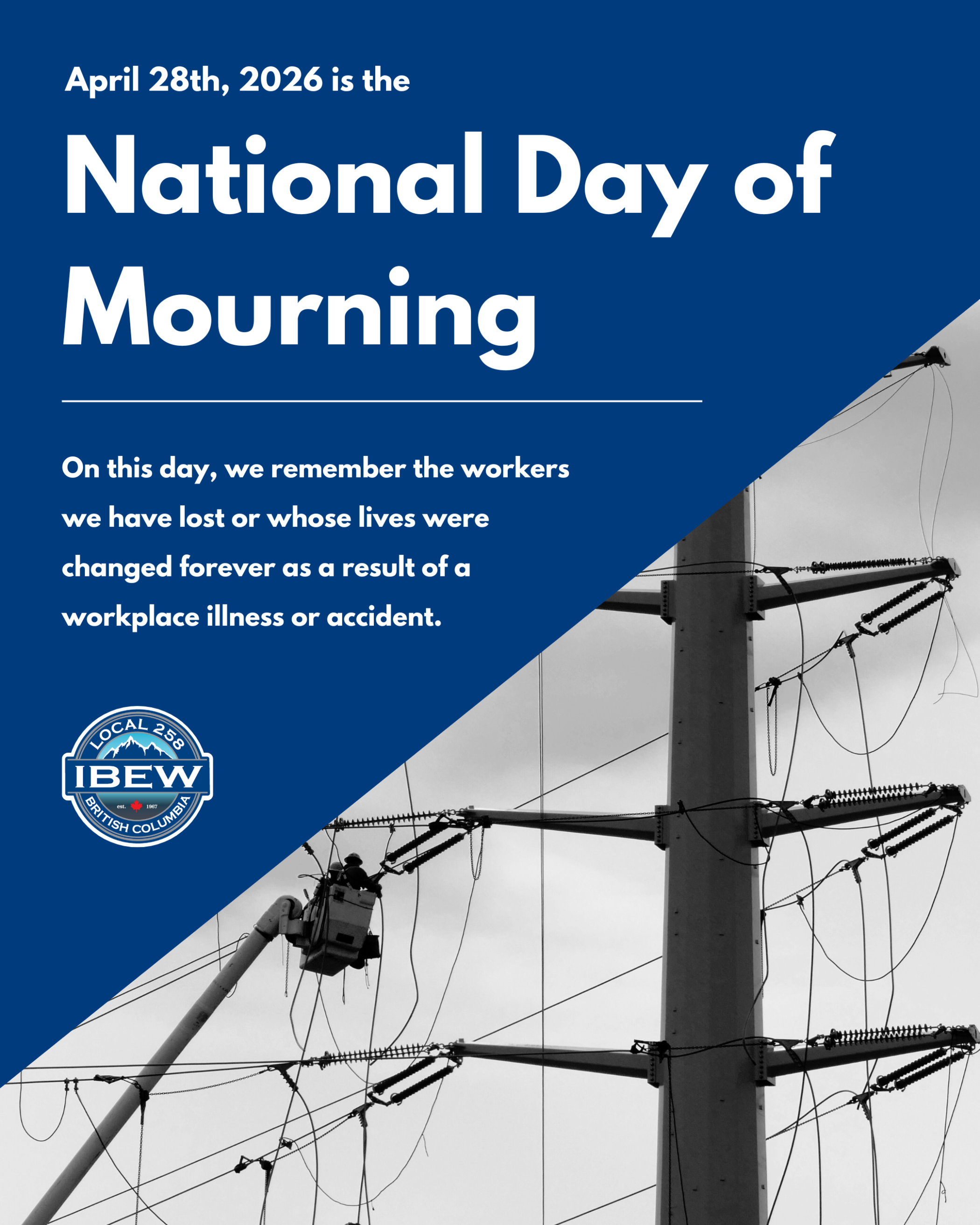
Every year on April 28, we observe the National Day of Mourning to honour the workers whose lives were lost or changed forever as a result of workplace accidents and illnesses. We remember the workers who never made it home, and stand with the families and communities they left behind.
While the National Day of Mourning is observed across all industries, it hits close to home in the skilled trades, where our work is inherently dangerous even when done correctly. According to statistics from WorkSafeBC, over 100,000 workplace injuries are reported annually across the province, with dozens of fatalities each year. The most significant portion of these incidents occur in construction and trades-related sectors—the fields in which IBEW members are heavily represented.
Workplace illnesses and fatalities are not random accidents; they are preventable. Post-accident investigations consistently show that many injuries and deaths stem from inadequate training, insufficient supervision, pressure to cut corners, or complacency.
For IBEW members, this speaks directly to the values in our Code of Excellence. Our strength has always come from looking out for one another. From apprenticeship training, to joint health and safety committees, to jobsite safety meetings, IBEW members are taught that safety is not optional—it is a shared responsibility. The protections we have today, including the right to refuse unsafe work and the right to proper training, supervision, and PPE were fought for by workers before us.
The Day of Mourning isn’t just about remembrance and reflection; it’s about accountability and action. It’s a call to examine how and why these accidents continue to happen, despite safety standards and regulations being stronger than ever. It's about speaking up, refusing unsafe work, and pushing for stronger protections, better training, and a culture where safety is never compromised for speed or profit.
We remember those we have lost not just through a moment of silence, but through action. Let’s make sure every single worker makes it home at the end of the day. No exceptions.
|






.jpg)




 500p for zoom.png)